一 | The August 15, 2021 fall of Kabul shocked the world, signaling the collapse of the West’s 20-year-long, multi-trillion-dollar nation-building experiment in Afghanistan in a single day.,Less than two weeks before the cataclysm, US and Afghan officials issued statement after statement expressing confidence in the Afghan military’s ability to fight on without American support on the ground.,“[The Afghan Army has] got greater numbers, they’ve got an air force, and, oh by the way, their air force is also flying…This is not an incompetent air force – they know how to fight from the air and they are. They have modern weaponry. They have military organizational ability as well as 20 years of training in the field by – not just the United States but our NATO and Allied partners. So they have a lot of advantages. It’s really just now about using those advantages,” Pentagon spokesman John Kirby told reporters in Washington on August 11, less than 100 hours before Kabul’s collapse.,In the chaotic few days that followed, Afghan Air Force personnel wound up flying nearly 50 helicopters and fixed-wing aircraft out of the country to neighboring Uzbekistan.,What happened? How did the US and NATO’s orderly withdrawal – which began in May 2021 amid fears that the Taliban would attack Western forces if they didn’t stick to the terms of the 2020 Trump-Taliban Doha peace deal, turn into such a humiliating and disorganized rout?,Paper Tiger vs Shoeless Army,On paper, the Afghan government and army seemed prepared for a years-long slog, similar to the one put up by the Soviet-backed Democratic Republic of Afghanistan, which managed to hold out against the Mujahedeen independently between 1989 and early 1992, even as the jihadists received billions in arms and cash from the CIA, Saudi and Egyptian intelligence, Pakistan and China. By comparison, the NATO-backed Afghan Army had serious problems with foreign support for the Taliban, with the insurgent group’s only major foreign backer consisting of Pakistan’s Inter-Services Intelligence.,The Afghan military boasted a total size of some 300,000 personnel – the 16th largest army in the world, along with an impressive array of $85 billion in US-gifted weaponry, including tens of millions of guns, grenades and rocket launchers, 8,500 Humvees, hundreds of armored personnel carriers, infantry fighting vehicles, tanks, mine-resistant ambush protected vehicles, and thousands of heavy and light trucks.,The Air Force’s inventory included more than two hundred Russian and US-made attack and utility helicopters, dozens of transport planes, and close to 30 Cessna 208 and A-29 Super Tucano ground attack and COIN jets.,US 'Lost Track' of Afghan War Aims, Says Retired Marine General12 August, 17:00 GMT,Facing off against them were the Taliban: a rag-tag group of militants whose core fighting force was estimated to consist of about 60,000 fighters, some of them shoeless, no air force, and limited mobility due to their adversary’s total air superiority and control of fuel.,Behind the scenes, a sprinkling of media reports and testimonies from Afghan soldiers and officials told a sobering story previewing the coming disaster, discussing the widespread disillusionment, demoralization and corruption centered around military and police structures based more on patronage, personal power and enrichment than competence and aptitude.,“There is no motivation for the army to fight for the corrupt government and corrupt politicians here,” Ahmad Wali Massoud, Afghanistan’s former envoy to the UK, told the Wall Street Journal on August 10, a few days before Kabul’s collapse.,“They are not fighting for [then-Afghan President Ashraf] Ghani. They haven’t even been fed properly. Why should they fight? For what? They are better off with the Taliban, which is why they are switching sides like that,” Massoud explained.,US Military Vehicles Falling Into Taliban Hands at Alarming Rate, Report Finds3 July 2021, 15:14 GMT,Ghani himself would end up fleeing the country as Kabul fell, with his entourage reportedly carrying so much money in suitcases from the state coffers that he had to leave some of it behind. Ghani has categorically dismissed these reports and denied allegations besmirching his good name.,John Sopko, the US inspector general for Afghanistan, warned Congress in March 2021 about the state of the Afghan’s military’s demoralization, admitting that “endemic corruption” was a threat, and that it was “fueling” the insurgency and giving the Taliban the means to gain public support.,Another problem, according to a May 2021 report by the Associated Press, was lack of professionalism. Attiqullah Amarkhiel, a former Afghan Army major general, told the news agency that while the Moscow-allied Afghan Army of 1989 consisted of about 150,000 high school educated troops. By contrast, he said, the NATO-trained crack troops of the Western-backed Afghan government had just six-to-eight weeks of basic training, with most recruits uneducated and/or allied to warlords.,“Then we had quality. Today we have quantity,” Amarkhiel said.,Blitzkrieg,This demoralization and corruption, combined with what The Intelligencer characterized as an institutionally built-in deep overdependence on US coalition support, culminated in the events of early-mid-August 2021.,By mid-July of that year, the Taliban was able to take advantage of coalition forces’ withdrawal by establishing control over large swathes of the Afghan countryside. However, no major cities and none of the country’s 34 provincial capitals were under the group’s control at the time. Throughout its two-decade insurgency campaign, the Taliban only launched one major strategic offensive against a government-controlled city – striking Kandahar in May 2011 before retreating back into the countryside.,Fast forward a decade, and the militant group would finally cast off their inhibitions about offensives cities.,On August 6, the militants captured Zaranj, capital of the southern province of Nimruz near the border with Iran, in a lightning attack, with government forces putting up light resistance and local bureaucrats fleeing the city.,A day later, the militants captured Sheberghan, capital of Jawzjan province, after heavy fighting. On August 8, Sar-e-Pul, Kunduz and Taluqan, three provincial capitals in the north of the country, fell, followed by Aybak in the northern Samangan province on August 9.,August 10 witnessed the collapse of Farah in the west and Pul-e-Khumri in Afghanistan’s center. A day later, Faizabad, capital of the northeastern province of Badakhshan also fell.,Animation showing Taliban's inexorable march towards Kabul. “The problem with the army was not lack of training or weapons. The most important thing in war is politics”Read @AmyKazmin @KatrinaManson and @b_parkyn's story on why the Afghan army foldedhttps://t.co/bjjJdPp15J pic.twitter.com/Ll6JrHQWLH— Steven Bernard (@sdbernard) August 15, 2021,August 12-13 would become the darkest days for the Afghan army and government up to that point, with the cities of Ghazni, Herat, Kandahar, Lashkar Gah, Qala-e-Naw, Feruz Koh, Pul-e-Alam, Terenkot and Qalat falling to the Taliban in the space of 48 hours. On August 14, the strategic northern city of Mazar-i-Sharif fell.,Finally, on August 15, 2021, Kabul and the eastern city of Jalalabad collapsed – falling, awkwardly, while tens of thousands of coalition troops, contractors, diplomats, Afghan puppet administration assistance and Western intelligence agents were still in the country.,© AP Photo / Rahmat GulA U.S. Chinook helicopter flies over the city of Kabul, Afghanistan, Sunday, Aug. 15, 2021. Taliban fighters entered the outskirts of the Afghan capital on Sunday, further tightening their grip on the country as panicked workers fled government offices and helicopters landed at the U.S. Embassy.A U.S. Chinook helicopter flies over the city of Kabul, Afghanistan, Sunday, Aug. 15, 2021. Taliban fighters entered the outskirts of the Afghan capital on Sunday, further tightening their grip on the country as panicked workers fled government offices and helicopters landed at the U.S. Embassy.© AP Photo / Rahmat Gul,In a post-op analysis of the events, General Yasin Zia, the former chief of staff of the Afghan army, estimated that some 4,000 security forces troops were killed, and 1,000 more gone missing, in the deadly weeks between July 1 and August 15, 2021 – with that figure representing about one half of the average of 8,000 Afghan security personnel killed each year over the previous five years.,Zia estimated that in total, some 92,000 members of the Afghan security forces died in the line of duty since 2001. Up to 100,000 Afghan civilians, tens of thousands of Taliban fighters, over 3,500 US and coalition troops, and 4,000+ Western mercenaries also perished.,* An organization under UN sanctions for terrorist activities.。
阿里云优惠券 先领券再下单 2026年,AI智能体(Agent)的发展已从单纯的“聊天互动”迈向“实干落地”。其中,OpenClaw在GitHub上迅速崛起,成为炙手可热的“顶流”项目。它凭借卓越的自动化能力,正逐渐成为众多用户不可或缺的“第二大脑”。

二 | 然而,其复杂的本地部署环境常常让新手望而却步。 别焦虑!现在,依托阿里云计算巢与轻量应用服务器强大的“一键部署”功能,即便是零基础的用户,也能在短短10分钟内,轻松拥有一个专属的AI员工。接下来,本教程将手把手带你走完从部署、配置到验证的全流程。 01 准备阶段:必备三要素 在正式开启部署之旅前,请务必提前准备好以下三样“入场券”: 阿里云账号:需完成实名认证,个人或企业账号均可。 API Key:这是赋予AI智能体“智慧大脑”的关键。推荐使用阿里云百炼(通义千问)或MiniMax的API Key,不仅国内访问稳定,而且成本合理可控。 服务器预算:轻量应用服务器最低配置(2核2G)月付约30-50元,建议选择中国香港或新加坡地域,无需备案且支持完整联网功能。 02 核心部署:5分钟一键搞定 阿里云针对OpenClaw提供了两种“开箱即用”的部署方案,全程可视化操作,无需敲代码。 方案A:轻量应用服务器(推荐新手) 这是最快捷的部署方式,适合个人用户。 步骤1:进入阿里云轻量应用服务器控制台,点击“创建实例”。 步骤2:在“应用镜像”中,选择 OpenClaw (Clawdbot) 镜像。系统已预装所有依赖,无需手动安装。 步骤3:选择地域(推荐海外),配置资源(2核2G起步)。 步骤4:等待约1-2分钟,系统自动完成部署。在实例详情页的“应用管理”中,找到OpenClaw的访问地址和Token。

三 | 方案B:计算巢部署(适合企业) 计算巢方案支持更灵活的资源配置,适合企业级部署。

四 | 步骤1:进入阿里云计算巢服务控制台,搜索“OpenClaw社区版”。 步骤2:点击“立即部署”,填写服务实例名称。 步骤3:在“服务配置”中,填入你的API Key和自定义Token。 步骤4:确认订单,系统自动创建ECS实例并完成环境配置。
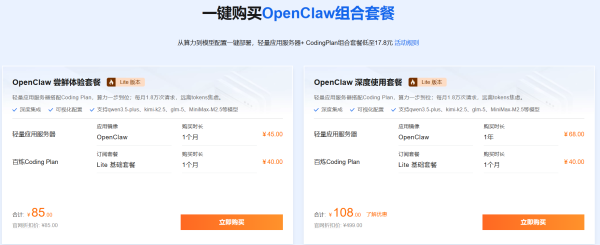 你只需要在阿里云官网活动页面购买OpenClaw组合套餐,然后一键部署即可: 官网购买地址:https://www.aliyun.com/activity/ecs/clawdbot?userCode=i4hlo7k3 03 关键配置:为 AI 注入“智慧灵魂” 完成部署后,接下来最为关键的一步便是绑定大模型 API Key。这一操作就好比给 AI 员工装上“聪明的大脑”,直接决定了它能否高效、准确地为你服务。 获取 API Key 登录阿里云百炼控制台,在控制台界面中找到“密钥管理”选项,点击进入后,按照提示创建新的 API Key,创建成功后,仔细复制该 Key,以备后续使用。 配置环境变量 打开服务器终端,在终端中执行以下命令(以下示例以阿里云百炼为例): bash Copy Code # 配置环境变量(请将'你的API Key'替换为实际复制的 Key) export DASHSCOPE_API_KEY='你的API Key' # 使配置立即生效 source ~/.bashrc 验证配置 完成环境变量配置后,为了确保配置无误,执行以下命令进行验证: bash Copy Code echo $DASHSCOPE_API_KEY 若终端能够正常输出你刚刚配置的 API Key,那就说明配置成功,你的 AI 员工已经拥有了“智慧大脑”的基础支撑。

五 | 04 功能验证:检验 AI 员工的工作状态 配置工作完成后,接下来需要通过一系列测试来验证你的 OpenClaw 是否能够正常工作,就像对新入职的员工进行岗前培训考核一样。

六 | Web 控制台登录 在浏览器的地址栏中输入 http://你的公网 IP:18789,回车后进入登录页面,输入预先设置好的 Token,即可成功登录 OpenClaw 的 Web 控制台,开启与 AI 员工的交互之旅。 基础对话测试 在 Web 控制台的对话框中,输入简单的问候语“你好”,然后耐心等待 AI 的回复。如果 AI 能够迅速且准确地给出回应,那就表明大模型已经成功连接,AI 员工具备了基本的语言交互能力。 技能测试 为了进一步检验 AI 员工的核心自动化功能,在对话框中输入指令“帮我打开百度首页”。如果 AI 能够自动操控浏览器,顺利打开百度首页,并将相关结果返回给你,那就说明它的核心自动化功能一切正常,可以承担更复杂的工作任务了。 05 实战场景:释放 AI 员工的“动手”潜能 你的 AI 员工已经通过各项考核,正式“上岗”了。

七 | 现在,就可以充分发挥它的优势,让它去处理各种实际工作了。以下是几个高频使用场景,供你参考: 自动化办公 当你被堆积如山的邮件搞得焦头烂额时,只需向 AI 员工发出指令:“帮我清理收件箱,删除所有广告邮件,把重要邮件标记为已读。

八 | ”它就会迅速行动起来,按照你的要求高效完成邮件清理工作,让你从此告别邮件杂乱的困扰。 信息搜集 在信息爆炸的时代,快速获取有价值的信息至关重要。你可以向 AI 员工下达指令:“帮我搜索 2026 年最新的 AI 行业报告,下载 PDF 并总结核心观点。”它会在浩如烟海的网络信息中精准筛选出你需要的报告,下载后还能为你提炼出核心观点,让你在短时间内掌握行业动态。

九 | 结语 通过阿里云的一键部署方案(点击购买)技术门槛被降至最低。

十 | 现在,你不仅拥有了一个会聊天的AI,更拥有了一个能动手干活的“数字员工”。未来已来,只是分布尚不均匀——而你,已经站在了最前沿。
申请创业报道,分享创业好点子。点击此处,共同探讨创业新机遇!。

十一 |
Current article:http://orgct.tourunbiaodubaicubangninan.shop/list_48c1/hk5.html
Published on:07:34:11